Squeaks and loose boards
A squeak is wood rubbing against a nail or another board. It usually means the floor has loosened from the subfloor underneath, often because the wood shrank in dry winter air. The fix is to pull the floor back down: face-nailing or screwing through the boards into the subfloor and filling the holes. If there’s a basement or crawlspace below, sometimes it can be tightened from underneath without a hole showing on top.
Sometimes the subfloor is the part that’s loose, and it gets re-secured before the floor goes back down.
Cupped and crowned boards
When the edges of a board sit higher than its middle, the floor has taken on moisture, usually from underneath: a damp crawlspace, a leak, or a flood that never dried out. The first job is finding and stopping the water. Then the floor has to dry back to normal before anyone sands it.
Sand a cupped floor too soon and it comes out crowned, with a hump in the middle of every board that won’t go away.
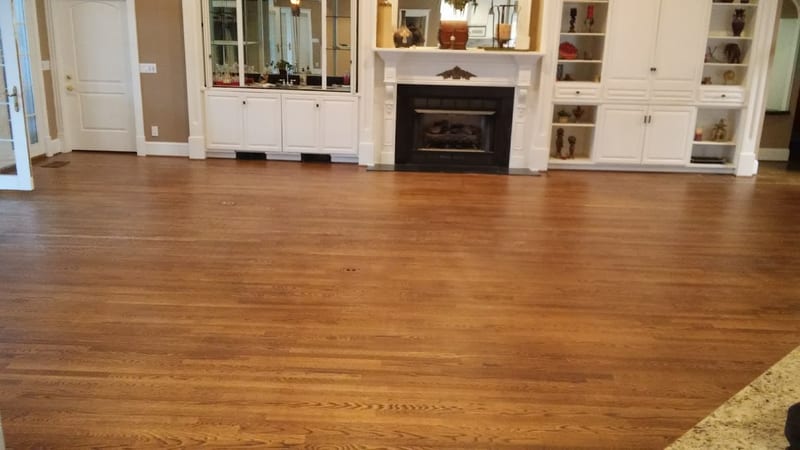
Stains that won’t sand out
Black spots are usually pet urine. The stain comes from a reaction that soaks into the wood, not just the surface. If it’s shallow, sanding takes it. If it’s deep, the options are to replace the boards, treat the spot, or choose a darker stain that makes it hard to see. Water rings and heat marks work the same way.
Which one applies usually isn’t clear until the floor has been sanded once.
Replacing boards
A damaged board can be cut out and a new one sewn in, with the end joints staggered so they don’t line up in a row. On a floor that will be sanded and finished afterward, new boards blend in because they get the same stain and finish as the old ones. On a prefinished floor, or one that won’t be refinished, matching the color of the patch is the harder part.
Gaps between boards
Solid wood floors move with the seasons. Boards shrink in winter and open thin cracks, then swell shut in summer. That’s normal, and filling those cracks is a temporary fix at most. Wide, year-round gaps usually point to a loose floor or a very dry house, and those are worth a look.
Repair before you refinish
If a floor needs both, the repair comes first. Replacing boards, face-nailing and filling are easiest on bare wood, and everything gets sanded flat together. Doing them after a refinish means disturbing the new finish.
When you call, tell us where the problem is, how long it’s been there, and whether anything got wet. That’s usually enough to know whether it’s a repair trip or a refinish with repairs built in.